
How S*xual Abuse Shapes Eating Behavior
Food can become the one predictable experience or a way to dissociate, a way to feel control inside a world that feels uncontrollable.


I have worked with a lot of people who struggle with food. I mean a lot.
People who binge.
People who restrict.
People who oscillate between the two.
People who feel out of control around food.
People who feel numb around food.
People who think about food constantly.
People who try not to think about food at all and wish they could just install a permanent IV to provide nourishment and never eat again.
Across years of clinical work, I’ve seen a pattern. Many, many, many of the people who now live with disordered eating or eating disorders experienced sexual abuse in childhood.
Not always, of course, but often enough that it deserves to fundamentally shape how we, as providers, understand eating behavior.
When you trace the origin story, something becomes really clear. Whatever survival behavior we’re talking about - whether it be restricting, bingeing, or any other eating behavior- started as a protective adaptation and protection.
For a child living in an unsafe body, unsafe home, or unsafe relationship, the nervous system does what nervous systems are designed to do. It adapts.
Food can become the one thing within reach, the one predictable experience, the one place where sensation can be turned up or turned down on demand.
Food can become a way to dissociate, a way to feel something when everything feels numb, a way to feel nothing when everything feels overwhelming, a welcome distraction, and a small pocket of control inside a world that feels uncontrollable.
Eating Disorders, Survival and the Nervous System
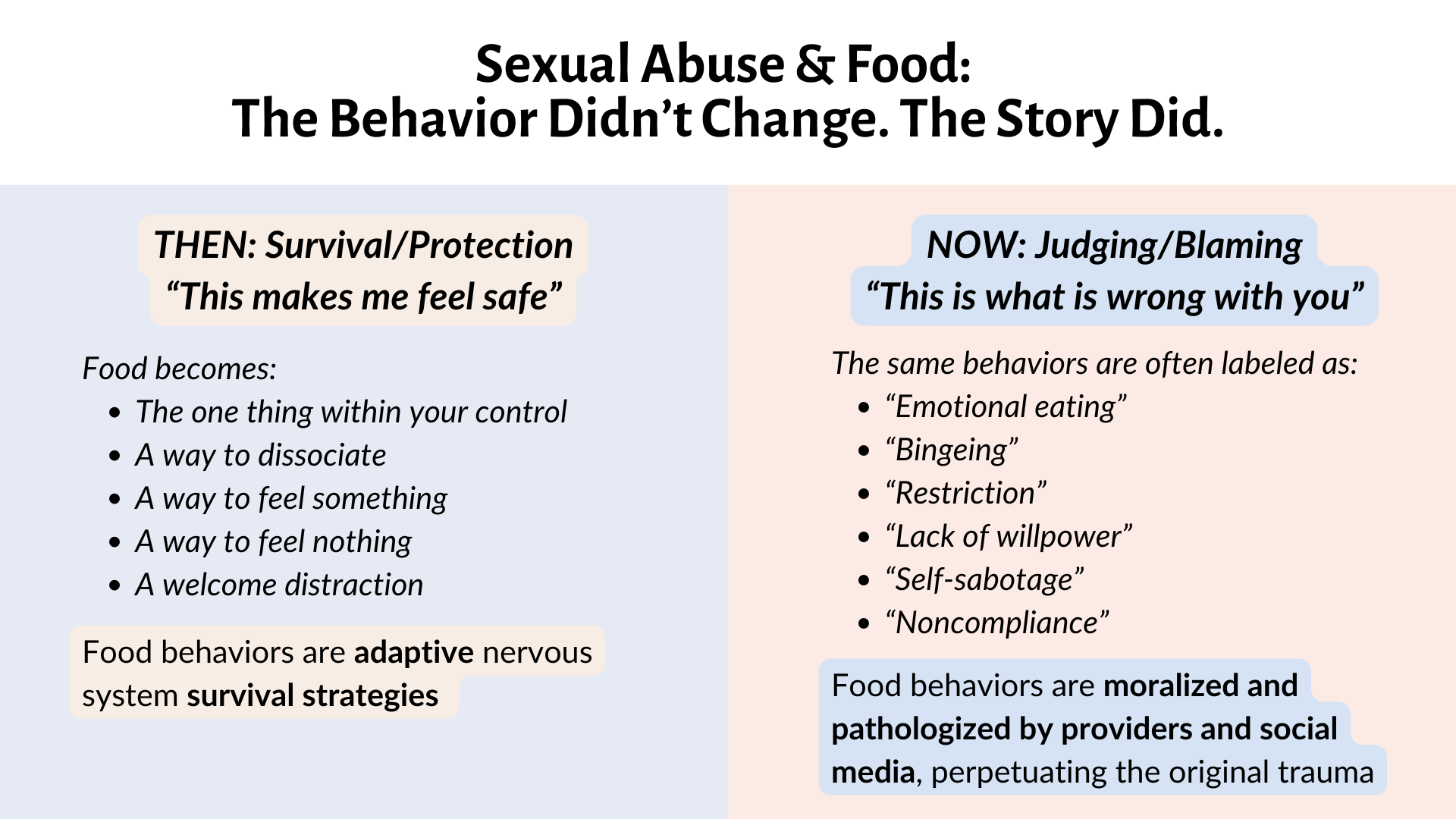
These patterns are adaptive nervous system survival strategies and intelligent solutions created in impossible circumstances.
The best phrase I can come up with to describe this nervous system pattern with food is: “This makes me feel safe, if only for a minute.”
Over time, bodies grow up. Contexts change. Environments shift. Hopefully, people get away from their abusers. But here’s the thing that’s challenging: often, the nervous system keeps using the same playbook.
Eating past fullness, eating in secret, not eating for long stretches.
Food as emotional regulation or restriction as a source of order.
Eating as soothing, numbing, grounding, or disappearing.
What changes is not the behavior. What changes is the story attached to it.
The same behaviors that once functioned as protection are now labeled by social media, some providers, and often friends and family as emotional eating, bingeing, restriction, lack of willpower, self-sabotage, or noncompliance (I really hate this word).
What once whispered “this makes me feel safe, if only for a minute” now screams “this is what is wrong with me.”

What We Need to Know as Nutrition Professionals
I can tell you one thing for sure: for these adults, shame feels familiar and so does threat. Being misunderstood feels familiar. Not finding a safe place to land feels normal.
People are often described as resistant, unmotivated, noncompliant, or hard to treat at this point. A more accurate description is that their nervous system is doing exactly what it learned to do in unsafe conditions. Protect. Survive. Stay alive.
Pathologizing these behaviors does not create change. Moralizing these behaviors does not create safety. Shaming survival strategies does not teach a nervous system how to feel safe.
It teaches the nervous system that the world is still dangerous. To be super clear for those that missed it, I’m specifically talking about the Mike Tyson Super Bowl Ad here.
If we work with food, bodies, trauma, or behavior change, we have an ethical responsibility to understand this.

From Real Threat to Normalcy to Cultural Normalization
I recently started taking a stand-up comedy class as a way to get through the dark Illinois winters. During the first class, the instructor showed an old Jerry Seinfeld clip that relied heavily on fat shaming and food shaming. I did not find it funny. Most of the room laughed. Loudly.
I remember sitting there feeling a familiar tightness in my chest. The same sensation I have felt many times, sitting with clients who describe being mocked, minimized, or dismissed for the ways they eat or the ways their bodies look.
I wished I had felt resourced enough in that moment to say, “This isn’t funny to me,” or to ask why shaming people’s bodies and eating is still considered acceptable comedy.
I did not say anything at the moment. I stayed through the rest of the class and decided I would not go back.
Later, I told a group of women friends about the experience. They met me with an immediate “Nope. That’s not okay.” Their validation helped me feel safe enough to email the instructor and let them know I would not be returning.
I am deeply aware of how privileged I am to have that kind of support. Many people do not. Many people sit alone with these moments, absorbing them quietly, adding them to a lifetime of messages that their bodies are wrong and their coping is shameful.
The reason I am sharing this story is not to center myself. It is to name something uncomfortable and important.
We are surrounded by cultural messaging that normalizes shaming people for their bodies and their eating. It shows up in comedy. It shows up in advertising. It shows up in social media. It also shows up in healthcare spaces.
We, as Providers, Can’t Be Neutral
If we are providers, we do not get to be neutral about this.
We do not get to look at food-based survival strategies in isolation from the environments that shaped them. We do not get to treat food adaptations as pathology simply because we do not like how they look. We do not get to demand regulated food behaviors from nervous systems that have never been offered safety.
Sexual abuse is, at its core, a profound violation of safety, autonomy, and bodily boundaries. Many survivors learned early that speaking up was dangerous, that their discomfort would be dismissed, that what was happening to them would be minimized or normalized.
Of course, as a licensed provider, I am a mandated reporter. Part of my job is to report instances of sexual abuse when I learn about them. At the same time, another critical part of my job is to work every day to avoid re-traumatizing people who have already survived abuse.
That means paying close attention to how food and eating behaviors are discussed, interpreted, and responded to. It means interrupting shame, blame, and food policing when I encounter it, even if it isn’t in my office. It means refusing to participate in narratives that frame eating as a moral failure.
I hope we can all get a little better at responding in the moment to food shaming (myself very much included), because for many trauma survivors, those moments are not small.